

India's steel industry is one of the largest in the world, supplying raw material to construction, automobile, infrastructure, and manufacturing sectors. With such a massive footprint comes equally massive responsibility — ensuring that every rod, bar, sheet, or pipe rolling out of a steel plant meets national safety and quality benchmarks. This is where the Bureau of Indian Standards (BIS) and its ISI certification come into play, and where the role of a skilled BIS ISI consultant becomes indispensable.
For steel manufacturers, obtaining ISI certification is not just a legal formality — it is a market necessity. Without it, products cannot be legally sold in several regulated categories, government tenders remain out of reach, and buyer trust takes a hit. Yet the certification process itself is layered with technical documentation, factory audits, testing protocols, and ongoing compliance checks that most manufacturers find overwhelming to handle alone.
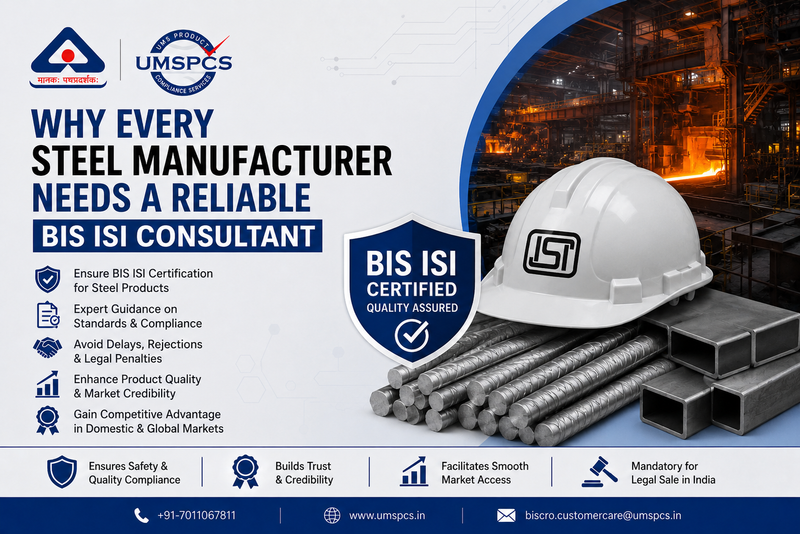
Understanding BIS ISI Certification for Steel Products
The ISI mark is India's most recognized quality certification, issued under the BIS Act, 2016. For the steel industry specifically, dozens of product categories — TMT bars, structural steel, GI pipes, wire rods, and more — fall under mandatory BIS certification schemes. This means manufacturers cannot legally manufacture or sell these products without a valid ISI license.
The certification process typically involves:
Submission of a detailed application with product and factory details
Factory inspection by BIS officials to assess manufacturing infrastructure
Sample testing in BIS-recognized or in-house NABL-accredited laboratories
Verification of quality control systems and documentation
Grant of license, followed by periodic surveillance audits
Each of these stages demands precision. A single procedural gap — incomplete documentation, an outdated quality manual, or a missed testing parameter — can delay certification by weeks or months. This is exactly the gap a professional consultant is built to close.
Read More:- BIS CRS certification in India
How a BIS Consultant Simplifies the Journey
A specialized Bis consultant does far more than fill out forms. Their value lies in translating regulatory complexity into a structured, manageable roadmap for the manufacturer. This typically includes:
Pre-assessment of factory readiness — identifying gaps in machinery, testing equipment, and quality control processes before the official BIS audit, so manufacturers don't face surprises during inspection.
Documentation support — preparing the quality control manual, test certificates, calibration records, and other paperwork BIS officials expect to see, all aligned with the latest IS standards applicable to the specific steel product.
Liaison with BIS officials — managing communication, scheduling, and follow-ups with the regulatory body, which often shortens turnaround time considerably.
Post-certification compliance — ISI certification isn't a one-time event. Licensees must maintain quality consistency and pass surveillance audits. A good consultant helps build internal systems so manufacturers stay audit-ready year-round, not just during renewal cycles.
For steel companies — particularly small and mid-sized manufacturers without a dedicated regulatory affairs team — this guidance often makes the difference between a smooth certification and a frustrating, repeated cycle of rejections.
Read More:- FMCS Registration In India
Why This Matters More Than Ever in 2026
The steel sector is under increasing scrutiny as the government pushes for stricter quality control orders (QCOs) across more product categories. Non-compliant manufacturers face market restrictions, and buyers — especially in infrastructure and government projects — are demanding ISI-certified inputs more rigorously than before. In this environment, having expert guidance isn't optional; it's a competitive advantage.
This is the space where platforms like 10xThink and certification specialists at UMSPCS have built focused expertise — helping steel manufacturers across India navigate BIS requirements without the usual back-and-forth delays. Their approach typically blends technical know-how of steel manufacturing standards with practical experience of how BIS offices actually function on the ground, which is often the difference between theoretical compliance and real-world approval.
Choosing the Right Consultant
Not all consultants offer the same depth of service. When evaluating a BIS ISI consultant for steel certification, manufacturers should look for:
Demonstrated experience specifically with steel product categories (not generic certification experience alone)
Transparent process timelines and clear documentation support
Strong relationships and communication channels with regional BIS offices
Post-certification support for surveillance audits and renewals
Honest assessment of factory readiness rather than unrealistic promises
A consultant who treats certification as an ongoing compliance partnership — rather than a one-time transaction — tends to deliver far better long-term outcomes.
Final Thoughts
BIS certification is the backbone of credibility in India's steel industry. While the regulatory process can feel daunting, the right consultant transforms it into a structured, predictable journey. From factory assessment to final license approval and beyond, expert guidance saves time, prevents costly errors, and positions manufacturers to compete confidently in both domestic and government markets.
FAQs
Q1. Is ISI certification mandatory for all steel products in India? Not all, but a significant number of steel product categories — including TMT bars, structural steel, and GI pipes — fall under mandatory BIS Quality Control Orders, making ISI certification compulsory for manufacturing and sale.
Q2. How long does the BIS ISI certification process take for a steel manufacturer? Timelines vary based on factory readiness and documentation, but the process generally takes a few weeks to a few months. Working with an experienced consultant often helps avoid delays caused by incomplete applications or failed inspections.
Q3. What happens if a steel manufacturer sells products without ISI certification? Selling mandatorily certified products without a valid ISI license can lead to penalties, product seizure, and legal action under the BIS Act, along with loss of market access for regulated categories.
Q4. Does ISI certification need to be renewed? Yes. ISI licenses require periodic renewal and are subject to ongoing surveillance audits by BIS to ensure manufacturers maintain consistent quality standards.
Q5. Can a small or mid-sized steel unit afford a BIS consultant? Most consultants, including those associated with platforms like UMSPCS offer scalable support tailored to the size and budget of the manufacturer, making professional guidance accessible even for smaller units.







Top comments (0)