
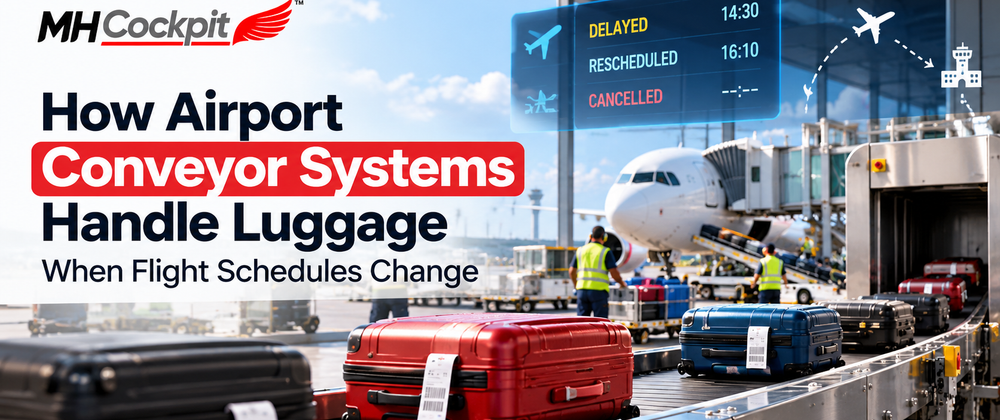

Airports handle thousands of passenger bags every day. But what happens when a flight is delayed, rescheduled or cancelled after luggage has already entered the baggage handling system?
This is where airport conveyor systems play an important role. They help ground handling teams move, sort and redirect luggage while coordinating with baggage tracking systems and airline operations teams.
Understanding how these systems work gives students an idea of the practical responsibilities involved in airport ground handling.
What Is an Airport Conveyor System?
An airport conveyor system is a network of moving belts and connected equipment used to transport passenger luggage between different areas of an airport.
These systems support several stages of baggage handling, including security screening, baggage sorting, transfer operations and the preparation of luggage for aircraft loading.
Depending on the airport's infrastructure, automated systems may use barcode scanners, baggage tracking technology and routing controls to direct bags to the appropriate handling areas.
How Do Conveyor Systems Handle Unexpected Flight Changes?
Flight schedules can change because of weather conditions, operational issues, aircraft availability or other disruptions. When this happens, airport ground handling teams may need to adjust how luggage is processed.
1. Redirecting Bags to the Correct Sorting Area
When a flight's assignment changes, baggage handling instructions may need to be updated. Where the airport's system supports it, conveyor routing can direct bags towards the appropriate sorting area.
Ground handling personnel monitor the process and intervene when a bag needs to be located or redirected manually.
2. Preventing Incorrect Baggage Loading
Before luggage is loaded onto an aircraft, baggage reconciliation procedures help verify that bags are associated with the appropriate flight and passenger records.
If a passenger is moved to another flight, ground staff may need to identify the passenger's luggage and arrange for it to be processed under the updated flight assignment.
This coordination helps reduce baggage loading errors.
3. Managing Luggage During Flight Cancellations
When a flight is cancelled, luggage that has already entered the outbound baggage process may need to be removed from it.
Depending on the situation, ground handling teams may arrange for bags to be held temporarily, transferred to another flight's handling process or returned to passengers.
Conveyor systems support the physical movement of luggage between designated areas, while staff and baggage management systems determine the appropriate next steps.
4. Handling Baggage for Multiple Flights
Airports process luggage for several arriving, departing and connecting flights simultaneously. An unexpected schedule change can increase the workload for baggage handling teams.
Conveyor systems help move and sort luggage across the airport, allowing staff to manage baggage flows without relying entirely on manual transportation.
However, performance depends on system capacity, accurate baggage information and coordination between the teams involved.
What Is the Role of Ground Handling Staff?
Although conveyor systems automate many baggage movements, ground handling personnel remain responsible for monitoring operations and resolving exceptions.
Their responsibilities may include:
- Monitoring baggage movement and sorting.
- Checking flight assignments and baggage records.
- Identifying and locating bags that have been misrouted.
- Coordinating baggage transfers when passengers change flights.
- Following baggage security and reconciliation procedures.
- Communicating with airline operations teams during disruptions.
The conveyor provides the physical movement, while the baggage handling system and ground staff coordinate the process.
Why Is Baggage Handling Relevant to BBA Aviation Students?
Baggage handling is one of the practical areas connected to airport ground operations. Learning how luggage moves through an airport helps students understand the coordination required between airline staff, ground handlers and airport systems.
Students interested in this field can also learn about aircraft turnaround operations, passenger handling, ramp services, airport safety and airline operations.
A BBA Aviation programme may introduce students to airport and airline management concepts, although the subjects and practical training available depend on the institution and its curriculum.
Those considering an aviation career can learn more about aviation education and training opportunities at MH Cockpit Aviation Academy in Chennai.
Conclusion
Airport conveyor systems help ground handling teams manage luggage when flight schedules change unexpectedly. By supporting baggage sorting, movement and rerouting, these systems help staff respond to delays, cancellations and flight reassignment.
However, conveyors are only one part of the process. Accurate baggage records, flight information, security procedures and coordination between ground handling teams are equally important.
For students interested in airport ground handling, understanding these operations provides a useful starting point for learning how an airport manages passenger luggage from check-in to aircraft loading and baggage reclaim.







Top comments (0)