

Artificial intelligence is becoming part of everyday life, from voice assistants and recommendation systems to educational applications and robotics. Students interact with these technologies regularly, but understanding how they actually work is equally important. How can a computer recognise an image, understand a question or make a prediction without being programmed with every possible answer?
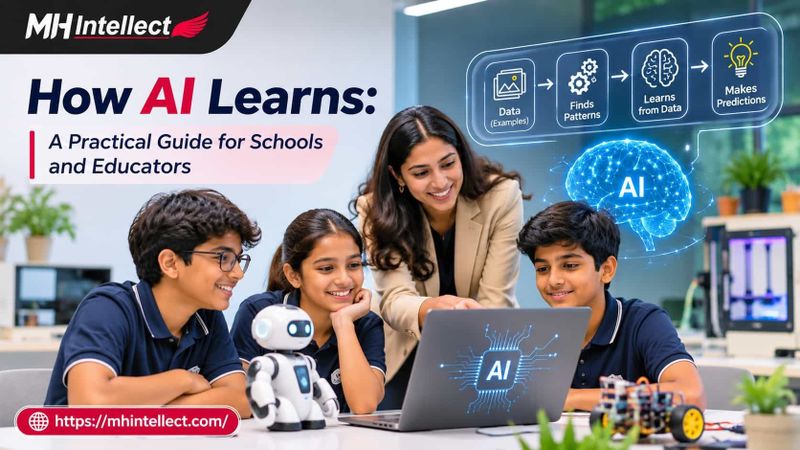
Understanding How AI learns for students helps educators introduce artificial intelligence beyond everyday technology use. It gives students an opportunity to explore how machines process information, identify patterns and generate predictions through mathematical models and machine learning.
How Does AI Learn from Information?
Artificial intelligence learns by analysing data, identifying patterns and adjusting its internal parameters during training. This process is commonly associated with machine learning, a branch of AI that allows computer systems to improve their performance using examples.
But how does AI learn? Consider an AI system trained using thousands of labelled pictures of apples and oranges. It examines visual characteristics such as colours, shapes and textures to identify differences between the two categories. When presented with a new image, the model uses the patterns identified during training to predict which fruit it contains.
This process is different from human learning. AI does not necessarily learn through personal experiences or emotions. Instead, it uses algorithms, mathematical calculations and training data to perform specific tasks.
How AI Learns from Data: The Training Process
The ability to learn from information depends on several connected stages. Understanding how AI learns from data helps students recognise what happens behind intelligent applications.
The typical machine learning process includes:
- Data Collection: Gathering relevant information such as images, text, audio recordings and numerical data.
- Data Preparation: Organising information and checking for errors, duplicates and missing values.
- Algorithm Selection: Choosing a suitable learning method based on the task.
- Model Training: Processing examples and adjusting internal parameters to reduce prediction errors.
- Model Testing: Evaluating performance using information the model has not previously encountered.
- Making Predictions: Applying learned patterns to new information.
- Monitoring and Improvement: Evaluating performance and updating models when necessary.
These stages help AI systems identify relationships within information and generate useful predictions.
How Artificial Intelligence Works in Everyday Applications
Understanding how artificial intelligence works becomes easier when students explore familiar examples.
An online shopping platform may analyse searches and previous purchases to recommend relevant products. An image recognition system identifies visual features to classify objects. Similarly, an educational application may analyse student responses to identify recurring mistakes and suggest additional practice activities.
Different applications use different machine learning approaches, including supervised learning, unsupervised learning, reinforcement learning and deep learning. Neural networks also help AI process complex information such as images, speech and language.
However, identifying statistical patterns does not automatically mean that an AI system understands information in the same way as a human.
Machine Learning Explained Through Practical STEM Activities
Machine learning explained becomes more meaningful when students experience its principles through practical activities.
For example, students can use a beginner-friendly machine learning tool to train an image classification model. They organise labelled pictures, train the model and examine its predictions. When the model makes mistakes, they can add more representative examples and test it again.
Other activities can introduce similar concepts:
- Robotics: Explore sensors, motors and automated responses.
- Coding: Understand algorithms, logical instructions and computational thinking.
- Artificial Intelligence: Investigate image classification and pattern recognition.
- Internet of Things: Learn how connected devices collect and exchange information.
- Data Analysis: Identify trends and use information to solve problems.
These activities connect technical concepts with practical learning. Schools can explore structured STEM programmes and implementation support to introduce emerging technologies through age-appropriate classroom experiences.
Preparing Students for an AI-Driven Future
AI systems are powerful, but they are not always accurate. They can produce incorrect information, reflect biases in training data or struggle with unfamiliar situations. Students must therefore learn to question AI-generated results, evaluate information and understand the limitations of technology.
This makes AI education an important part of developing digital literacy and responsible technology use. It also connects with the broader goals of UAE Vision 2031, which emphasises innovation, knowledge development and future readiness.
MH Intellect supports schools in introducing practical STEM learning through robotics, coding, artificial intelligence, IoT and other emerging technologies. By combining structured programmes with hands-on activities, schools can help students move beyond simply using technology to understanding how it works.
The goal is not just to teach students about artificial intelligence. It is to help them become confident learners who can question information, solve problems and participate meaningfully in a technology-driven future.







Top comments (0)