

Schools today face an important challenge: preparing students for a world shaped by artificial intelligence, automation, engineering and digital innovation. Traditional classroom instruction provides essential academic knowledge, but students also need opportunities to apply what they learn. This is where STEM education for schools plays an important role by connecting Science, Technology, Engineering and Mathematics through practical, problem-based learning.
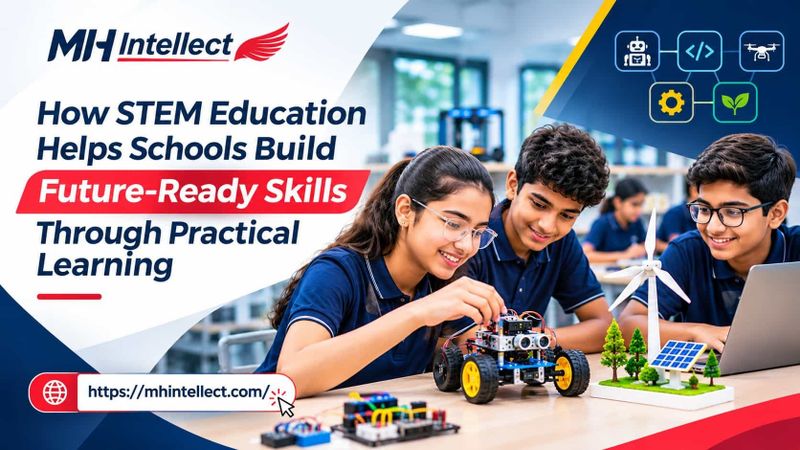
Rather than simply memorising concepts, students explore real challenges, develop ideas, test solutions and understand how different subjects work together. For school leaders and academic coordinators, introducing a structured STEM education approach is an opportunity to strengthen classroom learning while developing skills that students can use beyond school.
Why STEM Education Matters for Students
The value of STEM learning goes beyond technical knowledge. It encourages students to become active participants in the learning process. For example, when students build a robotic vehicle, they apply mathematics to measure distance, engineering principles to construct its structure, technology to programme its movements and scientific concepts to understand motion.
These practical experiences help students develop several essential capabilities:
- Problem-solving: Students investigate challenges, test different approaches and improve their solutions.
- Critical thinking: They analyse information and make decisions based on evidence.
- Creativity: They explore different ideas and develop solutions to practical problems.
- Collaboration: Team-based activities encourage communication, shared responsibility and teamwork.
These capabilities are valuable across academic subjects and future career paths. A well-designed STEM education programme gives students opportunities to practise these skills through meaningful activities rather than relying entirely on theoretical instruction.
Connecting Classroom Concepts with Practical Projects
One of the strongest advantages of STEM learning is its ability to connect different academic disciplines through a shared objective. Students can explore robotics, coding, 3D design, IoT projects and engineering challenges while understanding how classroom knowledge applies to real situations.
For instance, a smart classroom model may involve sensors to collect information, programming to control outputs, mathematics to interpret data and engineering principles to construct the model. Each activity gives students a practical reason to understand the concepts they are learning.
Schools can explore examples of these activities through STEM Education projects, which demonstrate how practical challenges can support technology-based learning and student engagement.
However, project activities should not remain isolated experiences. Their complexity needs to increase as students develop their knowledge and confidence. Early learners may begin with guided construction and observation, while older students can progress towards programming, automation, robotics and more advanced engineering challenges.
Why Schools Need Structured STEM Implementation
Introducing a robotics workshop or purchasing technology equipment does not automatically create an effective STEM learning environment. Meaningful implementation requires careful planning, curriculum alignment, teacher preparation and clearly defined learning outcomes.
School administrators should consider whether a programme matches students' age groups, supports existing academic objectives and provides teachers with the training needed to deliver activities confidently. It is equally important to evaluate whether students are genuinely exploring and solving problems or simply following predetermined instructions.
Working with an experienced STEM Implementation Partner can help schools plan and deliver programmes with appropriate learning progression, teacher support and practical implementation strategies.
Preparing Schools for the Future
Across Dubai, Sharjah and the wider Gulf region, schools are increasingly recognising the importance of developing technology awareness, scientific inquiry and practical problem-solving skills. These priorities also connect with the UAE's broader focus on innovation, knowledge development and future workforce readiness.
The UAE Vision 2031 provides a wider national context for strengthening education and preparing future generations for emerging opportunities. Structured STEM learning can support this direction by giving students opportunities to understand technology, explore engineering concepts and develop confidence in applying knowledge.
Schools can also demonstrate the practical outcomes of these learning experiences through a Student's Gallery, where examples of student activities and project work help parents and school communities understand what hands-on STEM learning looks like.
Building a Meaningful STEM Learning Environment
The purpose of STEM education is not simply to introduce more technology into classrooms. It is to help students ask meaningful questions, investigate unfamiliar challenges, test their ideas and develop solutions through practical experience.
For schools, achieving this requires a consistent approach that combines curriculum planning, age-appropriate projects, teacher development and long-term implementation support. By making STEM learning a structured part of education, schools can create opportunities for students to become confident thinkers, creative problem-solvers and active contributors to a technology-driven future.






Top comments (0)